Personal Information


Behrooz Parhami: 2008/09/29  ||  E-mail: parhami at ece.ucsb.edu  ||  Other contact info at: Bottom of this page

Go up to: B. Parhami's home page


This page contain information about Professor Parhami's life outside his profession.

  Return to: Top of this page

Likes and Dislikes

Pet peeve: Vehicles on UCSB campus walkways

Most favorite people: Those who carefully thread between trust and cynicism, using each where it benefits others.

Least favorite people: Those who blame others for their failures or claim all the credit for their successes.

  Return to: Top of this page

Books Read or Heard (most-recent first):

[2008 Sep.] Sharifian, Ruhangiz, The Day I Fell in Love a Thousand Times (Ruzi ke Hezar Baar Aashegh Shodam), collection of short stories in Persian, Morvarid Publications, 2005.

[2008 Aug.] Huffington, Arianna, Pigs at the Trough: How Corporate Greed and Political Corruption Are Undermining America, Crown, 2003. The corrupting influence of executive compensation that is disjointed from true performance, corporations’ exclusive focus on the bottom line, use of “creative accounting” to inflate revenues and profits to raise stock prices, and the way in which lobbyists extract government subsidies and softer regulations are described via case studies and statistics. Some of the data are truly eye-opening. However, the book is poorly structured and its explanations are dumbed down via repetitions and excessive use of tongue-in-cheek “humor.”

[2008 July] Loewen, James W., Lies My Teacher Told Me: Everything Your American History Textbook Got Wrong, unabridged audiobook read by Brian Keeler, Recorded Books, 1995.

[2008 July] Mack, Robert L. (ed.), Arabian Nights’ Entertainments, Oxford University Press, 1998. This 939-page paperback edition of the classic Thousand and One Nights is based on Antoine Galland’s 12-volume Mille et une Nuit (1704-1717) and its rendering into English by the anonymous ‘Grub Street’ translator (ca. 1706-1721). The main frame story concerns King Shahryar of Persia who, upon discovering his former wife’s infidelity, has her executed and comes to believe that all women are unfaithful. He begins to marry a succession of virgins, only to have each one executed the next morning. Eventually his vizier cannot find any more virgins. Scheherazade, the vizier’s daughter, offers herself as the next bride, with a plan to save many innocent women. On the night of their marriage, Scheherazade tells the king a tale, but does not end it. The king is thus forced to keep her alive in order to hear the conclusion. The next night, as soon as she finishes the tale, she begins another. And so it goes for 1001 nights. The tales told by Scheherazade are of Persian, Indian, Mesopotamian, and Egyptian origins. These are mostly classical folk tales of morality, virtues, and good-versus-evil, that are found among many cultures. Some can be traced back to the Persian Hezar Afsaneh or the Arabic Alf Khurafa, and their subsequent adaptations and mixings with tales of other parts of the world. Over the years, the stories have inspired many artists: musicians, poets, authors, movie makers, and so on.

[2008 July] Tyson, Neil deGrasse, My Favorite Universe, twelve lectures, The Teaching Company, 2003.

[2008 June] Hawking, Stephen (with Leonard Mlodinow), A Briefer History of Time, unabridged audiobook read by Erik Davies, Random House Audio, 2005.

[2008 June] Burke, James, The Day the Universe Changed: Pivotal Moments in Time that Radically Altered the Course of Human History, abridged audiobook read by the author, Audio Renaissance, 1990.

[2008 June] Nahai, Gina Barkhordar, Caspian Rain: A Novel, MacAdam/Cage, 2007.

[2008 June] Larson, Edward J., The Theory of Evolution: A History of Controversy, twelve lectures, The Teaching Company, 2002.

[2008 May] Poitier, Sydney, The Measure of a Man: A Spiritual Autobiography, unabridged audiobook read by the author, Harper Collins, 2000. Poitier describes the social context and circumstances of his youth and of his path-breaking career as a black actor, the first to win an Academy Award.

[2008 May] Feynman, Richard P., The Meaning of It All: Thoughts of a Citizen Scientist, unabridged audiobook read by Raymond Todd, Blackstone Audio, 2007.

[2008 May] Obama, Barack, The Odacity of Hope: Thoughts on Reclaiming the American Dream, Unabridged audiobook read by the author, Random House, 2006.

[2008 May] Shenon, Philip, The Commission: The Uncensored History of the 9/11 Investigation, Twelve, 2008.

[2008 Apr.] Ephron, Nora, I Feel Bad About My Neck: And Other Thoughts on Being a Woman, Unabridged audiobook read by the author, Random House, 2006.

[2008 Mar.] Milton-Edwards, Beverley, and Peter Hinchcliffe, Conflicts in the Middle East since 1945, Routledge, 3rd ed., 2008.

[2008 Mar.] Rich, Frank, The Greatest Story Ever Sold: The Decline and Fall of Truth from 9/11 to Katrina, unabridged audiobook read by Grover Gardner, Penguin Audio, 2006.

[2008 Feb.] Siegfried, Tom, A Beautiful Math: John Nash, Game Theory, and the Modern Quest for a Code of Nature, Joseph Henry Press, 2006. Discusses how game theory is invading many branches of inquiry in both physical and social sciences.

[2008 Jan.] Wallace, David Foster, Consider the Lobster and Other Essays, abridged audiobook read by the author, Time Warner Audio Books, 2005. Four essays: "Consider the Lobster", "The View from Mrs. Thompson’s", "Big Red Son", and "How Tracy Austin Broke My Heart".

[2008 Jan.] Angier, Natalie, The Canon: A Whirligig Tour of the Beautiful Basics of Science, unabridged audiobook read by Nike Doukas, HighBridge Audio, 2007.

[2007 Nov.] Bryson, Bill, The Life and Times of the Thunderbolt Kid: A Memoir, unabridged audiobook read by the author, Random House, 2006.

[2007 Nov.] Isikoff, Michael, and David Corn, Hubris: The Inside Story of Spin, Scandal, and the Selling of the Iraq War, unabridged audiobook read by Stefan Rudnicki, Blackstone Audio, 2006.

[2007 Oct.] Perkins, John, Confessions of an Economic Hit Man, unabridged audiobook read by Brian Emerson, Blackstone Audiobooks, 2005. EHMs earn a living by rendering strategically important Third-World countries dependent on, and thus under the influence of, the United States through convincing their leaders to accept enormous loans for infrastructure development and making sure that the resulting lucrative projects were contracted to US corporations, such as Bechtel and Halliburton.

[2007 Oct.] Voltaire, Candide, unabridged audiobook read by Tom Whitworth, Tantor Media, 2002. Originally published in 1759.

[2007 Sep.] Vonnegut, Kurt, God Bless You, Dr. Kevorkian, Audiobook read by Scott Brick, Books on Tape, 2000. This book of imaginary interviews with dead people began as a series of 90-second interludes for WNYC, New York City’s public radio station.

[2007 Sep.] Maugham, W. Somerset, Ten by Maugham, audiobook read/performed by various artists, KCRW FM, 2000. Collection of short stories, on 10 CDs.

[2007 Sep.] Anderson, Fred, The War that Made America: A Short History of The French and Indian War, Audiobook read by Simon Vance, Tantor Media, 2005. The Seven Years' War entailed expansion of the British colonies into French territory, in the context of the Native American struggle for survival. From the box cover: "... how America, as we know it today, emerged from a series of fractured colonies and warring tribes into a nation ripe for independence."

[2007 Aug.] Bacall, Lauren, By Myself and Then Some, abridged audiobook read by the author, Harper Audio, 2005. Updated version of the author’s memoirs on the silver anniversary of the original publication.

[2007 Aug.] Fernandez-Armesto, Felipe, Ideas that Shaped Mankind: A Concise History of Human Thought, The Modern Scholar Lecture Course Series, Recorded Books, 2004. Fourteen lectures based on Professor Fernandez-Armesto's 2003 book, Ideas that Changed the World.

[2007 July] American Society of Magazine Editors, The Best American Magazine Writing 2006, Columbia University Press, 2006. Diverse selections from feature articles, reports, profiles, commentaries, columns, essays, reviews, and short stories.

[2007 July] Johnstone, Bob, Brilliant! Shuji Nakamura and the Revolution in Lighting Technology, Prometheus Books, 2007. An account of the development high-brightness LED technology at a small Japanese company (Nichia), how that company foolishly chased away the goose that laid the golden egg, the legal intrigue as Nichia and Nakamura sued each other (the company claiming that Nakamura had leaked their trade secrets and Nakamura countering that his efforts in developing a billion-dollar business were inadequately rewarded), and the effects on world energy requirements when LED-based low-energy lighting replaces the current incandescent and fluorescent lightbulbs (e.g., saving an estimated 30% of the total energy used in the United States). The author has used numerous interviews with Nakamura and others, along with Nakamura’s Japanese-language autobiography, Breakthrough with Anger. This is an amazing story that is marred by some inconsistencies. For example, we learn on p. 62 that, circa 1987, “Nakamura had come to the conclusion that he should no longer listen to what his boss said . . . he would do the opposite of what people told him.” Then, on p. 214, more than a decade later, we read that “Like the loyal employee that he was, Shuji did as he was told.” However, given that the sources of information are primarily people who were (and some still are) involved in the technical developments and suits/countersuits regarding intellectual property, self-serving statements and the attendant conflicts are to be expected.

[2007 July] Zinn, Howard, A People’s History of the United States: Highlights from the Twentieth Century, audiobook read by Matt Damon and the author, Harper Audio, 2003. This audiobook comprises the second half of a book by the same name, expanded to include the Clinton presidency and other recent events. Traditional history is told from the viewpoint of “heros” (kings, generals, influential politicians), leaving out the resistance and suffering of victims of conquests, who, in their desperation, sometime turn on other victims. From the introductory comments by the author: “My viewpoint in telling the history of the United States is . . . that we must not accept the ‘memory of states’ [borrowing a phrase used by Henry Kissinger to define history] as our own . . . This book will be skeptical of governments and their attempts, through politics and culture, to ensnare ordinary people in a giant web of nationhood pretending to a common interest.”

[2007 June] Nemat, Marina, Prisoner of Tehran: A Memoir, Free Press, 2007. The author, born in 1965, was 16 years old when arrested by the Iranian regime two years after the Islamic revolution. This autobiography covers the author's life up to age 18, although it also contains brief accounts of the later years and her eventual resettlement in Canada. It is mainly the story of her imprisonment (a little over two years in the notorious Evin Prison) and marriage to one of her prison guards, Ali, who used his family ties to have her execution sentence commuted to life imprisonment. The prison stories are interlaced with formative events in the author's family life and schooling. It is very difficult to criticize someone who has been through so much and who has gathered the courage to write about private matters that most Iranians would not dare disclose. Yet, there are inconsistencies in the account that tarnish an otherwise compelling work of nonfiction. Foremost among these is the explanation of why she agreed to convert to Islam and to marry Ali, a man who claimed to be in love with her and yet was willing to use the threat of having her parents and a friend executed in order to force her to marry him. [Note added on 2007/09/20: Apparently, this book's depiction of the Evin Prison has touched some raw nerves. See, for example, the Persian review by Monireh Baradaran: http://www.akhbar-rooz.com/article.jsp?essayId=10487]

Gurwitch, Annabelle, Fired, Audiobook Produced by L.A. Theater Works, 2005. Comedic monologues about being fired from various, mostly trivial, jobs.

Green, Jane, To Have and to Hold, unabridged audiobook read by Kate Reading, Books on Tape, 2004.

Suskind, Ron, The One Percent Doctrine, unabridged audiobook read by George Guidall, Recorded Books, 2006. “. . . the most detailed, revealing account yet of American counterterrorism efforts and a hard-hitting critique of their direction.” [Publishers Weekly]

Berntsen, Gary, and Ralph Pezzullo, Jawbreaker – The Attack on Bin Laden and Al-Qaeda: A Personal Account by the CIA’s Key Field Commander, Audiobook read by Robertson Dean, Books on Tape, 2006.

Diamond, Jared, Guns, Germs, and Steel: The Fates of Human Societies, abridged audiobook read by Grover Gardner, HighBridge Audio, 2001. The author takes us on a journey that follows the development of human societies and uncovers several deciding factors that helped create the vastly differing levels of development on the various continents. According to The New Yorker, “The scope and explanatory power of this book are astounding.”

Friedman, Thomas L., The World Is Flat: A Brief History of the Twenty-First Century, abridged audiobook read by Oliver Wyman, Audio Renaissance, 2005.

Chomsky, Noam, Failed States: The Abuse of Power and the Assault on Democracy, Metropolitan Books, 2006.

Johnson, Steven, Mind Wide Open: Your Brain and the Neuroscience of Everyday Life, unabridged audiobook read by Alan Sklar, Tantor Media, 2004. Presents a lot of interesting facts, including how our brains have evolved to take care of certain routine tasks with little or no processing, and how a rough-and-quick processing center (the emigdula) manages to keep us out of danger when normal processing of sensory data would take too long for us to react in time.

Ricks, Thomas E., Fiasco: The American Military Adventure in Iraq, Abridged audiobook read by James Lurie, Penguin Audio, 2006.

Woodward, Bob, State of Denial: Bush at War, Part III, Abridged audiobook read by Boyd Gaines, Audioworks (Simon & Schuster), 2006.

Chomsky, Noam, Hegemony or Survival: America's Quest for Global Dominance, Metropolitan Books, 2003.

Clark, Richard A., The Scorpion’s Gate, unabridged audiobook read by Robertson Dean, Penguin Audio, 2005. Fictional tale set in the Middle East, circa 2010, and involving two fundamentalist Islamic republics: Iran and Islamyah (former Saudi Arabia, in which the al-Saud family has been toppled).

Friedman, Thomas L., The Lexus and the Olive Tree: Understanding Globalization, audiobook read by the author, Simon & Schuster Audio, 2004.

Phillips, Kevin, American Theocracy: The Peril and Politics of Radical Religion, Oil, and Borrowed Money in the 21st Century, Audiobook read by Scott Brick, Penguin Audio, 2006.

Young, Toby, The Sound of No Hands Clapping, unabridged audiobook read by Simon Vance, Tantor Audio, 2006.

Zoka’, Yahya, Dar Peeramoon-e Tagh’eer-e Khatt-e Farsi (On Changing the Farsi Script), Naghsh-e Jahan, Tehran, Dey 1329 (Jan. 1951), in Persian. This book provides an uneven history of attempts to improve the Farsi script in order to simplify its learning and reproduction. In some cases, the author names a proponent or opponent of the idea, without giving any details of his contributions to the debate; in other places, it quotes from letters and other writings at length. The writing style is also quite poor, with many sentences running half a page or longer.

Fonda, Jane, My Life So Far, Audiobook read by the author, Random House, 2005.

Ernest Hemingway: The Short Stories, Vol. 1, Audiobook read by Stacy Keach, Simon & Schuster Audio, 2002.

Remnick, David, and Henry Finder (eds.), Fierce Pajamas: Selections from an Anthology of Humor Writing from the New Yorker, Audiobook read by various people, The New Yorker, 2001.

Rahnema, Ali (ed.), Pioneers of Islamic Revival (New updated edition), Zed Books, 2005. Chapters from the 1994 first edition are titled Sayyid Jamal al-Din ‘al-Afghani’; Muhammad Abduh: Pioneer of Islamic Reform; Khomeini’s Search for Perfection; Mawdudi and the Jama’at-i Islami; Hassan al-Banna; Sayyid Qutb: The Political Vision; Musa al-Sadr; Ali Shariati: Teacher, Preacher, Rebel; Muhammad Baqer as-Sadr. A new 75-page introduction “Contextualize[es] the Pioneers” in view of the significant events of the past decade and sketches a “Roadmap to Understanding.” The following quotation (p. xv) is representative of the apologetic tone of much of the new introduction, because it conveniently ignores the facts that the one-man argument it postulates was supported by dozens of others who carried out, or provided logistical support for, the September 11 attacks and that the outcome of the attacks was celebrated by tens of thousands, while characterizing the reaction as being against Islam as a whole: “Essentially one man’s argument that Islam commanded such a killing laid the foundations of a wrathful reaction against Islam.” Near the end of the introduction, however, the editor strikes a different chord, noting that (p. lxxv) “Consumed by power, [pioneers of Islamic revival who entered the world of politics] lost patience and sacrificed the objects of the exercise, namely human beings who were to be properly guided” and (p. lxxvii) “a broad-based global re-examination and dialog is under way among Muslims of reflection as Muslims of desperation seemingly play out their last acts.”

Harrington, C. Lee and Denise D. Bielby (eds.), Popular Culture: Production and Consumption, Blackwell, 2001. A well-chosen and diverse collection of essays on various aspects of popular culture (e.g., television, magazines, music, sports, advertising) that reveals its exploitation for profit via tools such as celebrity and fandom.

Ehrenreich, Barbara, Nickel and Dimed: On (Not) Getting by in America, unabridged audiobook read by Cristine McMurdo-Wallis, Recorded Books, 2002. The author gains first-hand knowledge of the lives and working conditions of those struggling with near-minimum-wage jobs by temporarily abandoning her upper-middle-class life as a writer and trying to make ends meet while holding a string of such jobs.

Alba, Ben, Inventing the Late Night: Steve Allen and the Original Tonight Show, Prometheus Books, 2005. Describes how Steve Allen practically invented all the key elements of late night talk shows, now in common use, during his 1954-57 stint as the host of NBC’s Tonight.

Swarup, Vikas, Q & A, abridged audiobook, read masterfully by Kerry Shale, Harper Collins, 2005. A poor Indian orphan boy, working as a waiter, is arrested for fraud at the urging of producers of the TV quiz show “Who Will Win a Billion,” who have no intention of paying him after he wins the grand prize by correctly answering a series of 12 questions. In conversations with his attorney, the boy reveals how he luckily came to know the correct answer to each question through his life experiences with a few friends, masters, and other acquaintances. The audiobook has won several awards, including an Audie for abridged fiction.

Ehrenreich, Barbara, Bait and Switch: The (Futile) Pursuit of the American Dream, unabridged audiobook read by Anne Twomey, Audiobooks America, 2005. From the cover blurb: “. . . highlights the people who’ve done everything right – gotten college degrees, developed marketable skills, and built up impressive resumes – yet have become repeatedly vulnerable to financial disaster.” Offers interesting insights into the “career coaching” industry.

Fishman, Charles, The Wal-Mart Effect, unabridged audiobook read by Alan Sklar, Tantor Media, 2006. Discusses the hidden reach and transformative power of Wal-Mart via revealing its (mostly secret) operating principles and business practices.

Carroll, Jamuna (ed.), Television: Opposing Viewpoints, Greenhaven Press, 2006. Reprints of articles and other writings, arguing the two sides of controversial issues pertaining to the values that TV promotes, TV's societal impacts, effects of TV advertising, and methods of regulation.

Napoleoni, Loretta, Insurgent Iraq: Al Zarqawi and the New Generation, Seven Stories Press, 2005. The tale of how an insignificant dissident of modest means was artificially elevated to the status of a legendary terrorist to provide one of the two key justifications for the Iraq war. Though not explicated in the book, the events described suggest that the Iraq war might have been a preemptive strike not against Saddam Hussein, but against Islamic fundamentalism that was spreading in Iraq by Arab fighters, who did not have much to do in Afghanistan following the withdrawal of the Soviet Union and were looking to northern Iraq as their next battleground.

Wiesel, Elie, Night, Recorded Books, read by George Guidall, 2006. New translation, ©2006, from the original French by Marion Wiesel, the author’s wife. This classic novel/autobiography depicting gruesome experiences of Jews in Nazi Germany’s death camps was originally published in 1958. The author’s preface to this translation describes why a new translation was deemed necessary and also supplies additional insights and background.

Feynman, Michelle (ed.), Perfectly Reasonable Deviations from the Beaten Track: Selected Letters of Richard P. Feynman, Recorded Books, narrated by Richard Poe and Johanna Parker, 2005. This book reveals the human face of a key innovator of our time. The letters contents range from discussion of minor issues (e.g., in encouraging notes in response to students and other ordinary people) to important philosophical observations exemplified by the following insightful statement: “What is not surrounded by uncertainty cannot be the truth.”

Friedman, George, America’s Secret War: Inside the Hidden Worldwide Struggle Between America and and Its Enemies, Blackstone Audiobooks, read by Brian Emerson, 2004.

Petroski, Henry, Small Things Considered: Why There Is No Perfect Design, Alfred A. Knopf, 2003. I found this book on  the library shelf when looking for the next book on this list. It is a fascinating account of design tradeoffs and decisions in everyday items such as the plastic tripod (the “thingy” that prevents the top of a pizza box from sticking to the toppings), water glasses, paper cups, calculator and telephone keypads, doorknobs, and light switches.

Petroski, Henry, Success through Failure: The Paradox of Design, Princeton Univ. Press, 2006. Having read Petroski's very well-known book, To Engineer Is Human: The Role of Failure in Successful Design, many years ago, I was intrigued by the title of his new book and decided to acquire and read it. Like the aforementioned book, the theme here is the importance of learning from failures, as illustrated by the following quotation from p. 95: When a complex system succeeds, that success masks its proximity to failure. . . . Thus, the failure of the Titanic contributed much more to the design of safe ocean liners than would have her success. That is the paradox of engineering and design.

Yaqub, Salim, The United States and the Middle East: 1914 to 9/11, The Teaching Company, 2003. An audiobook  in the Great Courses series, composed of 24 lectures.

Ridgeway, James, The 5 Unanswered Questions About 9/11: What the 9/11 Commission Report Failed to Tell Us, Seven Stories Press, 2005. The questions, which form chapter titles, are: Why couldn’t we stop an attack from the skies? Why didn’t the Government protect us? Why didn’t we know what was coming? Did US “allies” help make the attacks possible? Why couldn’t the 9/11 Commission get to the truth?

Bergreen, Laurence, Over the Edge of the World: Magellan’s Terrifying Circumnavigation of the Globe, Harper Audio, 2003; Audiobook, read by the author.

Griffin, David R., The 9/11 Commission Report: Omissions and Distortions, Olive Branch Press, 2005. This book presents an interesting mix of ideas in an effort to discredit the 9/11 Commission Report. The main theme is that the report covers up or distorts evidence of serious ineptitude on the part of the administration (military leaders, in particular) and goes so far as to suggest that the attacks were perhaps deliberately allowed to succeed because a new "Pearl Harbor" would be useful to the administration's plans for world domination. Interest in having an oil pipeline from the Caspian Sea region to the Indian Ocean, via Afghanistan and Pakistan, as well as greater control over the oil fields of the Persian Gulf region, are cited as reasons for the Afghanistan and Iraq wars, which needed the 9/11 attacks as a pretext. Conspiracy theories are usually full of holes, and this one is no exception. The problems start on the very first page of Chapter 1, where the author uses the fact that six of the alleged hijackers showed up alive after 9/11 to cast doubt on the identity of the 19 men who carried out the attacks. Of course, there is no hint of the explanation that the hijackers may have forged those identities or that there may be multiple people named X Y in the world. Later, on page 25, the fact that "fire had never before caused steel-frame high-rise buildings to collapse" is cited as one of six problems in the official account. Again, the gaping holes in the towers are conveniently ignored and the focus is placed on fires, as if they were the sole causes of the twin towers' collapse. The hypothesis that a small plane or a missile, rather than a large airliner, hit the Pentagon (p. 38) similarly ignores the inconvenient fact that if this were true, Flight 77 must have crashed or been shot down somewhere else. The question then would be how the crash of such a large plane was not witnessed by anyone and how it was successfully hidden afterwards; or, if it did not crash, its passengers and crew must have been hidden or silenced. On page 42, President Bush is criticized for not leaving the school in Florida immediately after he learned of the WTC attacks, thereby "making all the students and teachers potential targets of a terrorist attack." However, it is not explained how his departure would have made the school less of a target in attacks that were planned days, if not months, in advance. Material in the latter half of the book, about distortions to hide inconsistencies and possible lies, as well as allegations of conflict of interest on the part of the 9/11 Commission members and staffers, are more believable. Thus, the book is still worth reading.

Friedman, Thomas L., Longitudes & Attitudes, Audio Renaissance, 2002, abridged audio book, read by the author (winner of 2002 Pulitzer Prize for commentary). A collection of columns written mostly in the months following the events of September 11, 2001. The author believes that while technology has facilitated worldwide communication, it has not improved our understanding and tolerance. In fact, because technology (the Internet in particular) allows people to select news sources that are most in tune with their own beliefs, it has helped build walls that hinder true understanding.

Preston, Richard, The Demon in the Freezer: A True Story, Random House, 2002, Audio book, read by James Naughton. The author paints a frightening picture of smallpox and anthrax as natural threats and as biological weapons. The tale of how selfless physicians and health workers eradicated smallpox as a natural disease is particularly impressive.

Ménoret, Pascal, The Saudi Enigma: A History, Zed Books, 2005. Reviews the history of Saudi Arabia via examining how the development of its current identity (that includes religious fundamentalism) and past and present political forces have affected its economy and society. Page 22 contains a revealing statement attributed to Benazir Bhutto, former prime minister of Pakistan: "the idea for the Taliban was British, the management American, the money Saudi and the groundwork Pakistani!"

Unger, Graig, House of Bush, House of Saud, Simon & Schuster Audio, 2004, read by James Naughton.

Greenberg, Karen J. (ed.), Al Qaeda Now: Understanding Today’s Terrorists, Cambridge, 2005. About 60% of this book is devoted to discussions by various experts and 40% to statements by OBL. The following quote, from page 5, aptly illustrates the attitude in the Arab world toward Al Qaeda and its leader: "In Saudi Arabia [the US has] a favorability rating of three percent, which is essentially zero. When polling is conducted in Saudi Arabia on bin Laden's political ideas, there is a fifty percent favorability rating. Interestingly, though, when we ask, 'Would you like bin Laden to be your leader?' the positive response is only five percent."

Berman, Ilan, Tehran Rising: Iran’s Challenge to the United States, Rowman & Littlefield, 2005.

Grisham, John, The King of Torts, Doubleday, 2003. Audiobook version, Random House, 2003, read by Michael Beck.

Satrapi, Marjane, Persepolis and Persepolis 2, Pantheon, 2003 and 2004. These "graphic novels" (which were followed in 2005 by Embroideries) depict the author's childhood and early adulthood in Iran and Europe. The books contain some worthy insights, but the few gems are far outnumbered by inaccuracies in characterizing sociopolitical events and gravely overshadowed by the author's tendency to blame individuals, events, and circumstances for her many failures. She paints unflattering portraits of several people, poking fun at their shortcomings, uptightness, or unattractive appearance, without acknowledging that those people too may have been victims of circumstances. In other words, while expecting everyone to be nonjudgmental toward her, the author does not cut these people any slack. On pp. 131-133 of Persepolis 2, she nonchalantly describes how, to avoid reprimand by the "decency police" for wearing makeup, she distracted them by accusing an innocent bystander of lewd conduct, knowing full well that the startled man would be in for a beating, at the very least. She never expresses remorse for putting an innocent man in grave danger (people have reportedly died from beatings during interrogations by the decency police); instead, she goes on to describe how moments later, her boyfriend laughingly praised her coolness and "instinct for survival."

Karolides, Nicholas J., Margaret Bald, and Dawn B. Sova, 120 Banned Books: Censorship Histories of World Literature, Checkmark Books, 2005. Divides the books into four 30-book sections depending on the primary reason for the bans: political (Doctor Zhivago, The Grapes of Wrath, 1984), religious (the three major holy books, Oliver Twist, On the Origin of Species), sexual (The Arabian Nights, Lolita, Ulysses), social (Anne Frank’s Diary, The Catcher in the Rye, Fahrenheit 451). The bans have occurred in many different countries, including England and USA.

Levy, Habib, Comprehensive History of the Jews in Iran: The Outset of the Diaspora, Mazda Publishers, 1999. Abridged and edited from the 3-volume Persian version by Hooshang Ebrami, Translated into English by George W. Maschke.

Goldin, Farideh, Wedding Song: Memoirs of an Iranian Jewish Woman, Brandeis Univ. Press, 2003.

Martel, Yann, Life of Pi, audiobook version, HighBridge, 2003. An intriguing story, read masterfully by J. Woodman.

Afary, Janet, and Kevin B. Anderson, Foucault and the Iranian Revolution: Gender and the Seductions of Islamism, University of Chicago Press, 2005. Foucault, a French philosopher, briefly acted as a journalist in Iran immediately before the Islamic Revolution. He wrote in glowing terms about the revolution for a short while, was harshly criticized for his views, and, apparently, later regretted his writings. Contains translated versions of Foucault’s writings, responses by critics, an in-depth analysis, and an epilogue entitled “From the Iranian Revolution to September 11, 2001”. Here is a noteworthy quote from an Iranian woman (Atoussa H.; p. 209 of the book), writing in response to Foucault: After twenty-five years of silence and oppression, do the Iranian people have no other choice than that between the SAVAK and religious fanaticism?

Conway, Flo, and Jim Siegelman, Dark Hero of the Information Age: In Search of Norbert Wiener, the Father of Cybernetics, Basic Books, xvi + 423 pp., 2005. Reviewed this book for Mathematical Reviews in 2005 (published in Vol. 2005i:01008, Review #2105723).

Howard, Roger, Iran in Crisis? Nuclear Ambitions and the American Response, Zed Books, London, 2004.

Pelfrey, Patricia A. (reviser/expander), A Brief History of the University of California, UC Press, 2nd ed., 130 + x pp., 2004. Traces UC's history from its conception at the constitutional convention in Monterey (1849), a year before California was admitted to the Union, through its official creation in 1868, to the present. Includes 1-2 pages on the specific history of each campus and complete lists of presidents and chancellors.

Mitnick, Kevin D. and William L. Simon, The Art of Deception: Controlling the Human Element of Security, Wiley, 2002. Mitnick, a convicted former hacker (nonmalicious to begin with, and now a changed man, if one is to believe him), shows how vulnerable we all are to social engineering, i.e., the use of influence, persuasion, or manipulation to deceive people. The book is full of examples of methods used to infiltrate systems. For instance, collecting seemingly innocuous pieces of information from employees and then putting them together to create the illusion of an insider to get even more information.

Dumas, Firoozeh, Funny in Farsi: A Memoir of Growing Up Iranian in America, Villard, 2003; paperback edition by Random House. This is a very funny book which focuses on a girl’s experience of growing up in a foreign land while being constantly embarrassed by the behavior and poor English skills of her parents.

Plath, Sylvia (1932-1963), Ariel, Harper Prennial edition, 1999. The poems in this book were written in the last months of Plath's life which ended by suicide in 1963, apparently in part due her husband’s (poet Ted Hughes) philandering.

Hsu, F.-H., Behind Deep Blue: Building the Computer that Defeated the World Chess Champion, Princeton University Press, 2002. Argues that the chess matches described should not be viewed as "human versus machine" but rather as "performing human versus tool-making human."

Nafisi, Azar, Reading Lolita in Tehran: A Memoir in Books, Random House, 2003. Recounts post-Islamic-Revolution Iran in four contexts related to her teaching of English literature: Lolita, Gatsby, James, and Austen. Describes how she was fired from a teaching post, went back to teaching, and eventually left Iran in 1997.

  Return to: Top of this page

Family and Other People

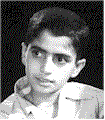
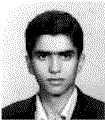
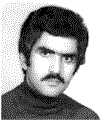
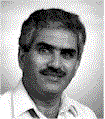
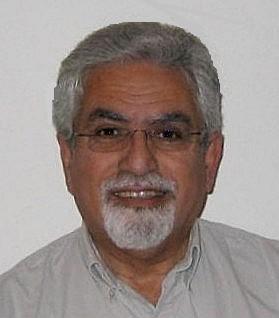
Self: one photo per decade, beginning with the 1950s


Wife: Vida Daie Parhami, separated since 2001.


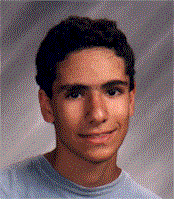
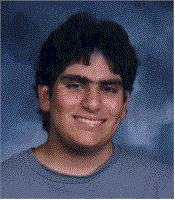
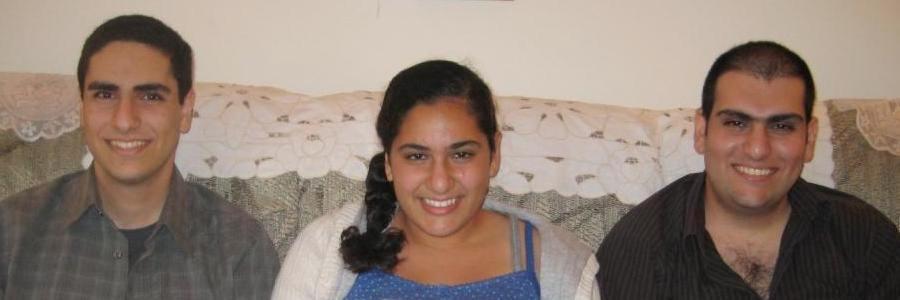
Children, left to right below (school photos from a few years ago, followed by newer ones from October 2005): Sepand (born 1986), Sepehr (born 1984), Sepideh (born 1994). In fall 2007, they are UCSB senior in computer engineering, UCSB recent graduate in economics, and in 8th grade, respectively.

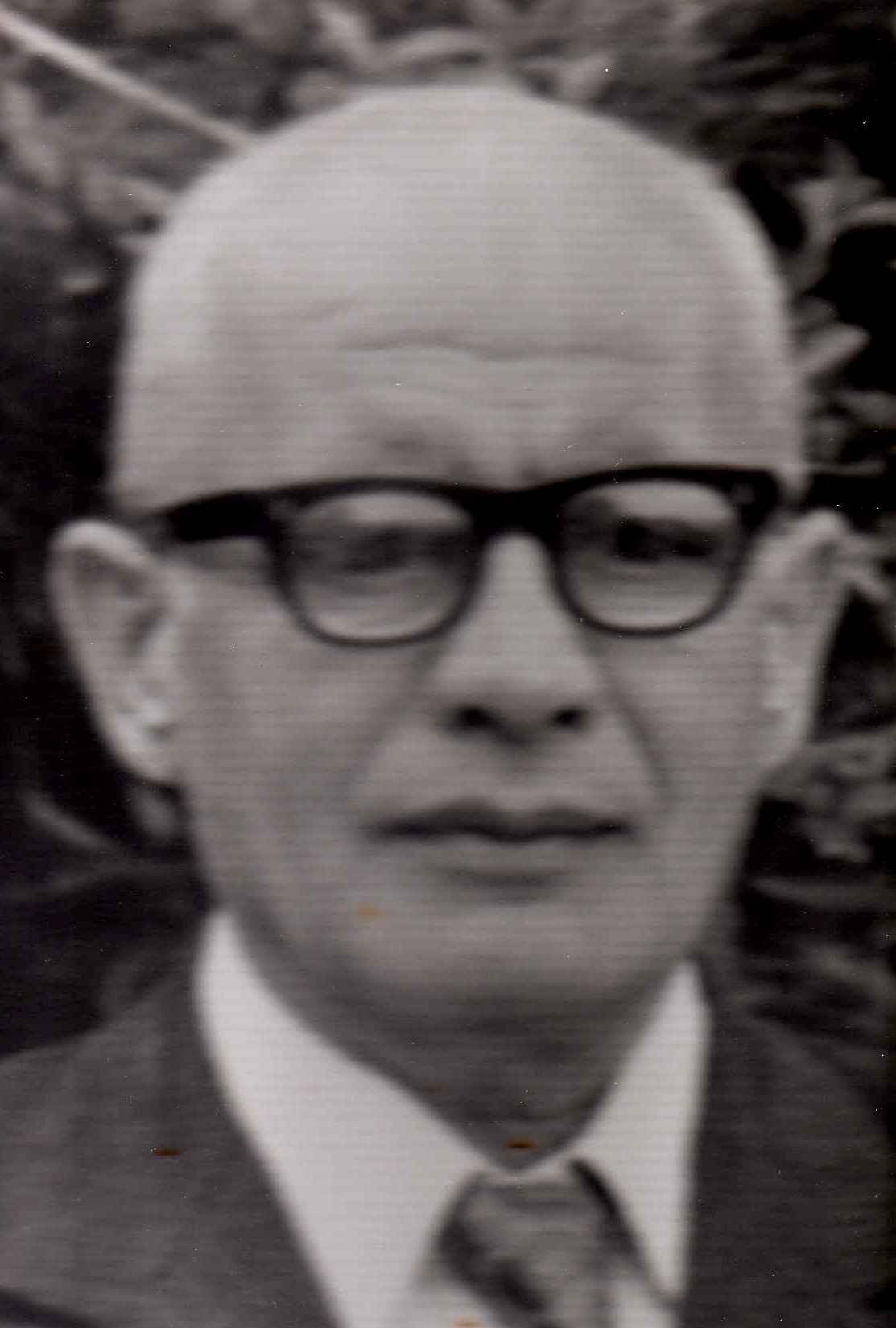
Father and mentor: Salem Parhami (1922-1992) -- Known to family and friends as "Mr. Engineer," Salem Parhami was a decent, hard-working, and industrious man whose 40+-year career included periods of employment as electrical engineer, engineering manager, educator, college administrator, and industrial consultant, before he retired to pursue his technical hobbies and freelance consulting. His encyclopedic knowledge and logical reasoning skills led relatives and acquaintances of diverse backgrounds to seek his advice on technical problems, writing projects, and sociopolitical matters. He authored 10 technical books in Persian and translated another two from English into Persian. All 12 volumes were highly successful and served as textbooks in Iranian universities for many years. He also published a collection of puzzles and other diversions for children and compiled a book of folk songs from his beloved Kurdistan province. His clever solutions to mathematics and science problems, derived over long hours of discussion and help with high-school homework, facilitated Professor Parhami's development in these areas and greatly influenced his subsequent career path.
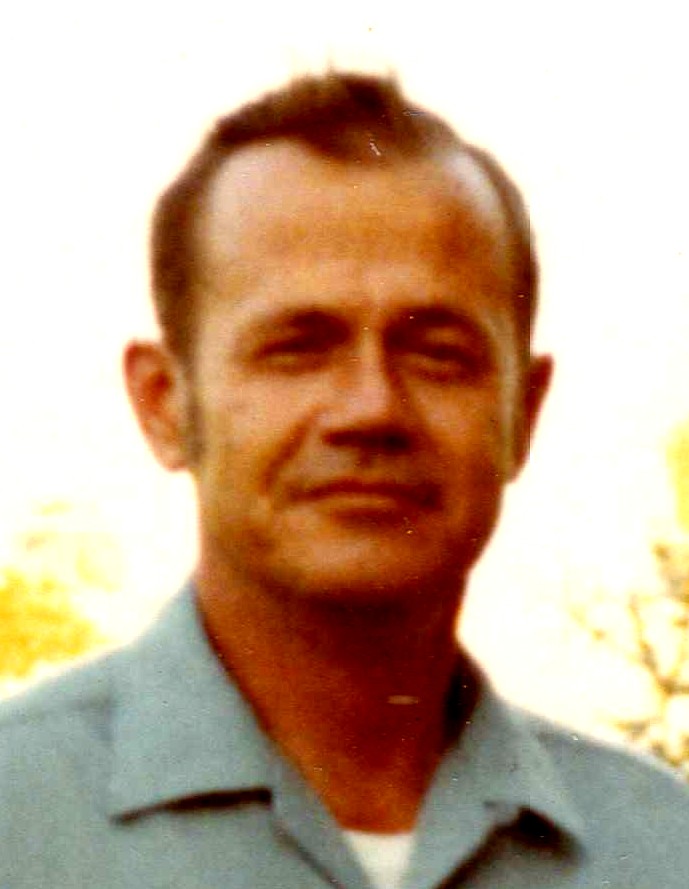
Mentor: Robert Allen Short (1927-2003) -- Professor Short (PhD, Stanford) joined the faculty of the Electrical Engineering Department at Oregon State University in 1966 and later became the founding Chairman of its Computer Science Department. He passed away in September 2003 following a lengthy illness (for obituary, see IEEE Computer, December 2003, p. 104). Professor Parhami studied with, and wrote an MS thesis under the direction of, Professor Short at OSU during 1969-70. He  remembers Professor Short fondly as a knowledgeable and caring mentor. Professor Short introduced Professor Parhami to switching theory and finite-state machines; other than elementary programming in Fortran, these were Professor Parhami's first exposure to computer science and engineering and were quite influential in his career path and choice of research direction. In his role as the Editor of IEEE Transactions on Computers, Professor Short helped and encouraged Professor Parhami to publish his first journal paper based on his master's thesis research on stochastic sequential machines. The paper is item 1 in B. Parhami's publication list.

Mentor: Algirdas Antanas Avizienis (1932-) -- Professor Avizienis (PhD, Illinois, 1960) joined the Computer Science Department at the University of California, Los Angeles, in 1962 and chaired it during 1982-85. Professor Avizienis directed research programs on dependable computing and fault-tolerant systems both at UCLA and at JPL, where he led the development of the STAR (self-testing-and-repairing) computer for NASA. Initiation of the annual conferences on fault-tolerant computing in 1971, which continue to date, and of the IFIP Working Group on Reliable Computing and Fault Tolerance are among his important leadership activities. Professor Avizienis has received many awards and citations for his technical contributions and leadership roles (for more info, see http://www.avizienis.info/index-en.html). Professor Parhami studied with, and wrote his PhD dissertation under the direction of, Professor Avizienis at UCLA during 1970-73. Given Professor Parhami's short one-year stay at Oregon State University for his master's degree and his prior specialization in electrical engineering, the years at UCLA and Professor Avizienis' guidance were highly influential in his subsequent career and research direction. Studying with an international leader in dependable computing and one of the world's foremost experts in computer arithmetic engrained these two areas, as well as the love of leading-edge research, in Professor Parhami's conscience. Items 3, 6-8, and 28 in B. Parhami's publication list resulted from Professor Parhami's PhD research under Professor Avizienis.


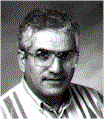
Above, from left to right: Salem Parhami, Prof. Robert Short, and Prof. Algirdas Avizienis

People from Ferdowsi Elementary School, Tehran

Under construction

People from Sadd-e-Karaj High School (grades 7-11), Tehran

Under construction

Teachers: ? Alebouyeh (Arabic), ? Faghih (Farsi), ? Gharagozlou (principal), ? Razavi (math)

Classmates: Bijan Afshār, ? Aghājāni, Parviz Ahoubim, Dāvoud Bāsseri (Tehrani), Mehrdād Dastouri, Kāmbiz Foroutan (Foroutanzād, Zolkhāie), ? Khājeh, Shahnām Mohājerin, Moussā Moshfegh, ? Nassiri, ? Rabbāni, ? Sedehi (twins), Esmāeil Talāei, ? Zamāni, ? Zarrin-far

People from Alborz High School (grade 12), Tehran

http://my.alborzi.com/

Under construction

Teachers: ? Esfandiāri (physics), Jafar Golbābāei (superintendent), ? Golshan (Persian literature)

Classmates: ? Amir-Mo'ezzi, ? Dārā, Mehrdād Dastouri, Hamid Jalālzādeh

People from Tehran University's School of Engineering (Dāneshkadeh-ye Fanni)

Under construction

Professors: ? Bāzargān (mechanics), Parviz Jabbehdār (computer programming), Khosro Karimpanāhi (strength of materials), Mohammad-Ali Mojtahedi (calculus), ? Soltāni, Mohammad Zanganeh, ? Zoueshtiāgh

Classmates: Hamid (Khan) Afshār, Rezā Agāhi, Bijan Aghdāie, ? Bahmanpour, Heshmatollāh Beheshti-Zavārei, Eliās Bereliān, Mehrdād Dastouri, Khalil Dānā, Farāmarz Dāvariān, Hossein Eghtesādi, Farrokh Elmieh, Nematollāh Enāyati, Siroos Fakhr-Yāsseri, Mohammad Ferdowsi, Assadollāh Garroussi, Javād Jamāli, Mostafā Joharifard, Mohammad-Rezā Fātemi, Hossein Feshāraki, Assadollāh Foroughiān, Mohammad-Rezā Foulādgar, Mortezā Ghāssemi, Yousef Ghorbāniān, Abbāsgholi Katirāee, Issā Khayyer-Habibollāhi, ? Kolāhdouz-Esfahāni, Mohammad-Hossein Kourang-Boroujerdi, Parviz Mahmoudzādeh, Ahmad Māleki-Sharifi, Rezā Manouchehri-Nāini, Mohammad-Hossein Massoudi, Mohammad Moddarres-Yazdi, Nāsser Mohājerāni, Mohammad-Rezā Mohazzab, Sohrāb Morādi, Farāmarz Nassiri, Kāmboziā Pezeshk-Najafi, Mohammad-Javād Peyroviān, Javâd Pourjabbār, Mahmoud Pourmansouri, Parviz Rafiee-Nejād, Bijan Ra'iyyati, Mahmoud Razmjouyān (deceased), Servat Rostamkhāni, Farrokh Sāedi, Homāyoun Saffâriān, Siāmak Sālehi-Lorestāni, Youssef Salimpour, Mortezā (Mort) Shāyegān, Mortezā Shole', Nāji Shomas, Hormoz Teymooriān, Alexānder Thomāsiān, Hassanāli Vahhābi, Ali Zamāni, Mohammad-Rezā Zāre', Assaddollāh (Bijan) Zargarbāshi

Contemporaries from other majors: Sirous Fakhr-Yāsseri, Homāyoon Heshmati, Hamid Jalālzādeh, Farhād Mossāvāt

People from Oregon State University, Corvallis, USA

Under construction

Professors: Harry Goheen (theory of computation), Robert A. Short (digital logic), ? Stone (real-time systems)

People from UCLA

Under construction

Professors: Algirdas Avizienis (computer arithmetic, fault tolerance), Bertram Bussell, Alfonso F. Cardenas (data bases), Jack Carlyle (theory of computation), Wesley Chu, Gerald Estrin (computer systems), Walter Karplus, Leonard Kleinrock (computer networks), Allen Klinger, David F. Martin (automata theory), Michel A.  Melkanoff (programming languages), Richard R. Muntz (performance evaluation), Judea Pearl, Gerald J. Popek, Jacques Vidal

People from Sharif (formerly Arya-Mehr) University of Technology

Colleagues: Mohammad-Javād Ashjaee, Mohammad Ghodsi, Gholāmhossein Hamedāni, Ali-Akbar Jafariān, Fahimeh Jalili, Behrokh Khoshnevis, Farhād Mavaddat, Bahman Mehri, Abolghāssem Miāmee, Armen Nahāpetiān, Jamshid Parvizi, Gholām-Ali Semsārzādeh, Boroumand Shahdād, Siāvash Shahshahāni

Return to: Top of this page

Hobbies

Mathematical recreations

Word puzzles

Reading

Poetry: Here are six of B. Parhami's Persian poems celebrating the Persian new year (spring 2008, 2007, 2005, 2004, 2003, and 2002)


  Return to: Top of this page

Favorite Quotes

Here are some of B. Parhami's favorite quotes, both serious and humorous. Most of these come from secondary sources, so accuracy in wording or attribution is not guaranteed.

    On love and friendship

Getting people to like you is merely the other side of liking them.” Norman Vincent Peale.

“Love is a strange commodity, because you can't import it if you don't also export it.” © Ashleigh Brilliant (Pot-Shots).

“In the arithmetic of love, one plus one equals everything, and two minus one equals nothing.”  Mignon McLaughlin.

“A friend is one who knows all about you and likes you anyway.”  Christi M. Warner.

When a friend is in trouble, don't annoy him by asking if there is anything you can do. Think up something appropriate and do it.” Edgar Watson Howe.

“Shared joy is a double joy; shared sorrow is half a sorrow.”  Swedish proverb.

“Advice is what we ask for when we already know the answer but wish we didn't.”  Erica Jong.

“The real art of conversation is not only to say the right thing in the right place but to leave unsaid the wrong thing at the tempting moment.”  Dorothy Neville.

“A gossip is someone who talks to you about others, a bore is someone who talks to you about himself, and a brilliant conversationalist is one who talks to you about yourself.”  Lisa Kirk.

    On life and time

“We make a living by what we get. We make a life by what we give.”  Winston Churchill.

“Don't be afraid your life will end; be afraid that it will never begin.”  Grace Hansen.

“Look over your shoulder now and then to be sure someone's following you.”  Henry Gilmer.

“Almost every man wastes part of his life attempting to display qualities which he does not possess.”  Samuel Johnson.

“An autobiography is the story of how a man thinks he lived.”  Herbert Samuel.

“Time is a great teacher, but unfortunately it kills all its pupils.”  Hector Berlioz.

“Experience is a comb which nature gives us when we are bald.”   Chinese proverb.

“Remember that as a teenager you are in the last stage of your life when you will be happy to hear the phone is for you.”  Fran Leibowitz.

“The years between 50 and 70 are the hardest. You are always asked to do things, and yet you are not decrepit enough to turn them down.”  T. S. Eliot.

“There are so many things that we wish we had done yesterday, so few that we feel like doing today.”  Mignon McLaughlin.

“A committee takes hours to put into minutes what can be done in seconds.”  Judy Castrina.

“A meeting is an event in which the minutes are kept and the hours are lost.”  Gourd's axiom.

“Life is a long lesson in humility.”  James M. Barrie.

   On home and family

“Home is not where you live, but where they understand you.”  Christian Morgenstern.

“The woman cries before the wedding and the man after.”  Polish proverb.

“Before marriage, a man will lie awake all night thinking about something you have said; after marriage, he'll fall asleep before you finish saying it.”  Helen Rowland.

“To marry a second time represents the triumph of hope over experience.”   Samuel Johnson.

“Spouse: Someone who'll stand by you through all the trouble you wouldn't have had if you'd stayed single.”  Anonymous. 

“Children are a great comfort in your old age -- and they help you reach it faster too.”  Lionel Kauffman.

“Give to a pig when it grunts and a child when it cries, and you will have a fine pig and a bad child.”  Danish proverb.

“Children have never been very good at listening to their elders, but they have never failed to imitate them.”   James Baldwin.

Parents can tell but never teach, unless they practice what they preach.”  Arnold Glasow

   On fathers and fatherhood

A father carries pictures where his money used to be.  Anonymous

When I was a boy of 14, my father was so ignorant I could hardly stand to have the old man around. But when I got to be 21, I was astonished at how much he had learned in seven years.”  Mark Twain

Fatherhood is pretending the present you love most is soap-on-a-rope.”  Bill Cosby

To be a successful father, there's one absolute rule: when you have a kid, don't look at it for the first two years.”  Ernest Hemingway

When a father gives to his son, both laugh; when a son gives to his father, both cry.”  Jewish Proverb

A man knows he is growing old because he begins to look like his father.”  Gabriel Garcia Marquez

He who is taught to live upon little owes more to his father's wisdom than he who has a great deal left him does to his father's care.”  William Penn

The fundamental defect with fathers is that they want their children to be a credit to them.”  Bertrand Russell

It doesn't matter who my father was; it matters who I remember he was.”  Anne Sexton

It is admirable for a man to take his son fishing, but there is a special place in heaven for the father who takes his daughter shopping.”  John Sinor

We think our fathers fools, so wise we grow. Our wiser sons, no doubt will think us so.”  Alexander Pope

By the time a man realizes that maybe his father was right, he usually has a son who thinks he's wrong.”  Charles Wadworth

I must study politics and war so that my sons may have liberty to study mathematics and philosophy. My sons ought to study mathematics and philosophy, geography, natural history, naval architecture, navigation, commerce and agriculture in order to give their children a right to study painting, poetry, music, architecture, statuary, tapestry, and porcelain.”  John Adams

  On character and disposition

“The highest perfection of politeness is only a beautiful edifice, built, from the base to the dome, of graceful and gilded forms of charitable and unselfish lying.”  Mark Twain

If your thought is a rose, you are a rose garden; and if it a thorn, you are fuel for the fire.”  Rumi (Masnavi).

“Pessimist: a man who thinks everybody as nasty as himself, and hates them for it.”  George Bernard Shaw.

“To the optimist all doors have handles and hinges; to the pessimist, all doors have locks and latches.”  William Arthur Ward

“There is no sadder sight than a young pessimist.”  Mark Twain.

“An optimist may see a light where there is none, but why must the pessimist always run to blow it out?”  Michael de StPierre.

“The greater part of our happiness or misery depends on our dispositions and not our circumstances.”  Martha Washington.

“What you cannot enforce, do not command.”  Socrates.

“We grow a little every time we do not take advantage of somebody's weakness.”